Chapter 2 starts with a discussion of myths and legends that include knitting references. or more importantly the lack there of. one of Rutt's favorite things, it appears, is to poke holes in other research, but back it up with nothing. for example, Mary Thomas apparently tells a Yemeni story about Eve knitting the pattern on the snake's back. Rutt's response is that she gives no verifiable source (pot meet kettle) and then states that even if it is real, it's trivial and therefore proves nothing.
One of the most objectionable things about Rutt is his own sense of self-importance. He regularly calls out other authors for not bothering to give sources, etc, but gives none of his own. he makes comments like "the words obviously mean..." and "the pious william felkin..." ad hominim attacks disprove nothing.
his comments about Christ's garment that was diced for, might very well be correct. it seems likely that a bishop might actually know a lot about biblical references, to bad he doesn't share them.
The Esch fragments and a word about words. Rutt states: "the oldest datable pieces of what is claimed as knitted fabric were found...." the word claim comes with quite a lot of baggage unfortunately. claim implies disbelief. so these fragments--they were found in a 2nd century grave in southern Holland. in 1966 the two fragments were examined by a textile technologist, J. E. Leene. J. E. Leene appears, from a quick search on Google to be a well respected textile scientest, so it seems legitimate to trust JE's conclusions. JE concluded that indeed they were structurally stockinet, altho they were attached to a backing of some sort.
Rutt's response is typical. they don't fit well into his theory of when knitting began (much much later), so he discounts them as perhaps unique, or not actually knitted items, "they must have been made by hand, but we cannot say what tools were used."
Nalbinding discussion. what follows is a fairly long discussion of nalbinding from the Middle East. it's important to consider several things when discussion nalbinding. if as is at least possible, knitting developed OUT of nalbinding, then some of the discussion is irrelevent. the discussion primarily involves a piece of nalbinding found in 1933. or 3 pieces. altho two are completely ignored by Rutt, the one, which is apparently rather sizable, includes a decrease technicque that Rutt asserts is not convenient with knitting, but is convenient with nalbinding, and therefore the piece must be nalbound. in spite of this claim, Barbara Walker, in her Second Treasury of Knitting Patterns gives the Dura-Europos patterns, which are quite knittable. Rutt again makes statements that are questionable here: the work was probably done in the round (why does he think this?) and may be part of a sock (why again?).
moving on to Romano-Egyptian socks. there are several collections that house these socks. they certainly appear to be nalbound (one of the easy ways to tell is the numerous yarn joins that are round in nalbinding but not in knitting), and recent discussion seems to agree that these are nalbound. with an entire piece it is much easier to establish whether an item is knitted or not because of those pesky joins.
in his discussion of Mediaeval Egypt Rutt discussing a fragment that was part of a swiss textile experts collect (his name was Fritz Ikle). a photgraph of the fragment is published in Mary Thomass Knitting Book (1938 p91). unfortunately the fragment is no longer extant. Ilke dated the fragment to 7th-9th centuries, but as typical, Rutt simply discounts it since it is not extant. This piece is in crossed stockinet. the next pieces are not. the blue and white Islamic socks and fragments of knitting that are generally accepted as dated to between 1000-12000 AD of Egyptian finds. none have been carbon dated, so it is impossible to know specific dates. the pieces which are all relatively similar and very unlike the nalbinding that predates them, are likely the oldest knitting extant.
Rutt states at this point that nalbinding has given way to knitting sometime between 500 and 1200 AD. a darned long time that. and moreover, if the colorwork pieces that are extant are the earliest examples, it is clear that knitting started substantially before these pieces were made. any knitter could attest to the fact taht this involved colorwork knitting, with detailed colorwork was clearly not a "first generation" of knitting. it is unlikely, actually, that these pieces were even in the first hundred years.
tomorrow, moving on to the cushions of Las Huelgas....the earliest dated European knitting examples.
Tuesday, March 01, 2011


Friday, February 25, 2011
friday night with Rutt
yes, i'm aware i have NO life. so here i am discussing chapter 1. chapter one is called definitions and techniques. for the most part, let me say in advance that i agree with rutt's definitions. the chapter is mostly straight forward and pretty easy to understand. initially be provides what i'd generally consider to be a good definition of knitting--except of course, he fails to do anything in this definition to eliminate naalbinding that is identical to cross-stitch knitting. in order for his definition to be truly accurate it is reasonable to require that the fabric be produced with either a frame or multiple needles, or something. otherwise, the definition will include some naalbinding. oops.
then he goes on to discuss various other methods of producing fabric that is similar to knitting and might be mistaken for knitting. he leaves out one notable technique that when viewed from the front only looks almost identical to knitting--soumak weaving. on the front soumak weaving produces the vs of knitting, and only when viewed from the back can one tell it is not knitting simply by looking at it. this is important to note ecause later he discusses items where the back cannot be seen and simply concludes that they are knitting without further discussion.
Rutt then moves on to a discussion of actual knitting. in this he proceeds on with more linguistic discussion that makes absolutely no citations, so it's hard to tell where he got his info from, or if it is simply his own supposition. for example, he states that the term stockinet was probably derived from "stocking net", while this seems to be generally accepted in the dictionaries that i looked at, it would be nice to see where he concluded that. additionally he proceeds to put forth the claim that the spelling stockinet is older and better, again with no explanation. this utter lack of explanation is very frustrating. footnotes would have been most helpful, and done little to make the book less readable.
moving on the the casting on and binding off discussion--it apears that he fails to address longtail cast-on which is probably the most commonly used cast-on today. this seems like a bit of an odd omission. he also only discusses a single bind-off method and in such terminology that it's difficult to know which bind-off he's actually referring to. all throughout this, there are lots of comments that fail to give any evidence of why they are true, occassionally just referring to other books that he states have no justification either. this is shoddy research at best. if there is no evidence (for example) of what bind on was mostly commonly used in england until the 20th century, it would best to not try to explain, especially not when what evidence is suggested exists, is not given.
when discussing handling knitting needles, there are again lots of holes in the research. there are comments like: "The cottagers could 'knock off the loops' of their coarse stockings, but the ladies usually worked with silk or fine Berlin wool to produce delicate items. They thought of their work as artistic and refined." all of these comments may be accureate. perhaps cottage knitters did 'knock off the loops' of their coarse stockings, perhaps ladies worked with silk or fine Berlin wool, and produced delicate items, and perhaps they thought of their work as artistic and refined, but Rutt offers NO evidence of any of this. none. research claims like this should have some source to back them up. it brings up further questions about whether Rutt simply published his own thoughts, or whether there wsa actual research that this was based on. some simple footnotes would make the book a much more usable research item. unfortunately as it stands, one can't even go and find where Rutt reaches his conclusions, or why. makes for not good research.
furthermore, he then states that the "older way to knit" involves holding one needle still and moving the other. it is likely that he is correct (the oldest evidence of how knitting was done is later in the book in the knitting madonnas. it is unfortunate that he fails to explain how his conclusions were reached. most of the rest of the chapter seems largely irrelevent, discussing such things as knitted wire and whther knitting should be considered an art or a craft.
it is understandable that Rutt did not feel like publishing footnotes or giving explanations of his conclusions, the problem is that his failure to do so makes the book almost unusable as a research tool. short of simply purchasing all the books in the bibliography and going through each one and hoping that the same conclusion is reached that Rutt reached, the book is simply "fun reading" if one likes that sort of thing. what is most disturbing is the way that Rutt's book has been heralded as the current go-to book on the history of knitting. this is fine, as long as being able to research for oneself is unimportant.
tomorrow, before 1500.
then he goes on to discuss various other methods of producing fabric that is similar to knitting and might be mistaken for knitting. he leaves out one notable technique that when viewed from the front only looks almost identical to knitting--soumak weaving. on the front soumak weaving produces the vs of knitting, and only when viewed from the back can one tell it is not knitting simply by looking at it. this is important to note ecause later he discusses items where the back cannot be seen and simply concludes that they are knitting without further discussion.
Rutt then moves on to a discussion of actual knitting. in this he proceeds on with more linguistic discussion that makes absolutely no citations, so it's hard to tell where he got his info from, or if it is simply his own supposition. for example, he states that the term stockinet was probably derived from "stocking net", while this seems to be generally accepted in the dictionaries that i looked at, it would be nice to see where he concluded that. additionally he proceeds to put forth the claim that the spelling stockinet is older and better, again with no explanation. this utter lack of explanation is very frustrating. footnotes would have been most helpful, and done little to make the book less readable.
moving on the the casting on and binding off discussion--it apears that he fails to address longtail cast-on which is probably the most commonly used cast-on today. this seems like a bit of an odd omission. he also only discusses a single bind-off method and in such terminology that it's difficult to know which bind-off he's actually referring to. all throughout this, there are lots of comments that fail to give any evidence of why they are true, occassionally just referring to other books that he states have no justification either. this is shoddy research at best. if there is no evidence (for example) of what bind on was mostly commonly used in england until the 20th century, it would best to not try to explain, especially not when what evidence is suggested exists, is not given.
when discussing handling knitting needles, there are again lots of holes in the research. there are comments like: "The cottagers could 'knock off the loops' of their coarse stockings, but the ladies usually worked with silk or fine Berlin wool to produce delicate items. They thought of their work as artistic and refined." all of these comments may be accureate. perhaps cottage knitters did 'knock off the loops' of their coarse stockings, perhaps ladies worked with silk or fine Berlin wool, and produced delicate items, and perhaps they thought of their work as artistic and refined, but Rutt offers NO evidence of any of this. none. research claims like this should have some source to back them up. it brings up further questions about whether Rutt simply published his own thoughts, or whether there wsa actual research that this was based on. some simple footnotes would make the book a much more usable research item. unfortunately as it stands, one can't even go and find where Rutt reaches his conclusions, or why. makes for not good research.
furthermore, he then states that the "older way to knit" involves holding one needle still and moving the other. it is likely that he is correct (the oldest evidence of how knitting was done is later in the book in the knitting madonnas. it is unfortunate that he fails to explain how his conclusions were reached. most of the rest of the chapter seems largely irrelevent, discussing such things as knitted wire and whther knitting should be considered an art or a craft.
it is understandable that Rutt did not feel like publishing footnotes or giving explanations of his conclusions, the problem is that his failure to do so makes the book almost unusable as a research tool. short of simply purchasing all the books in the bibliography and going through each one and hoping that the same conclusion is reached that Rutt reached, the book is simply "fun reading" if one likes that sort of thing. what is most disturbing is the way that Rutt's book has been heralded as the current go-to book on the history of knitting. this is fine, as long as being able to research for oneself is unimportant.
tomorrow, before 1500.
Thursday, February 24, 2011
A history of Handknitting by Richard Rutt
i obtained this book some months ago--maybe even a year or so--and i had up until now just sort of browsed my way through it. recently i decided to start going through it chapter by chapter. there are variety of issues with the book as a real history of anything. i've heard it referred to by SCA people as the "bible of knitting" claiming that in the future there will be "BR" and "AR" --before Rutt and after Rutt. my plan is to go through the book a bit at a time, posting my thoughts about what is good scholarship, and what is not. so...today, the preface and introduction (or at least part of it).
the preface of this work really changes many things about it, if you actually read it. Rutt states that this is a pioneer essentially in discussion of hand knitting. in this it is true. i've looked at many of the books that were published prior to this and they simply aren't very researched. he then goes on to say that this is an amateur work, uneven and incomplete. this is completely true. having browsed the rest of the book i can tell you that Rutt fails to make much of any effort to look at any literature that is not English. for example, (in my copy on page 58 in Before 1500) his last comment about 15th century Pomerania is: "these pieces have been described only in Polish and Latvian respectively, so we cannot yet know their significance." this type of comment in a book that proposes itself as a "history of handknitting" is truly disturbing. a friend suggested that the book was essentially "a romp" through the books in english about knitting. if it had been stated as such, it wouldn't concern me nearly as much.
Rutt goes on to state that since it isn't an academic thesis he has left out notes and page references. this is bad enough, but it also only contains a "select bibliography" implying that there are book references completely left out. all and all, this is quite concerning as a piece of research that is being referenced regularly by people. it is, at best, mostly a tertiary source that contains some fairly good quality black and white photographs. (oh by the way, almost none of the photographs are Rutt's own, all seem to be borrowed from other books, implying in some cases that he never went and looked at the items since he reproduces errors from other books in some cases). Rutt's conclusions are regularly questionable in numerous ways....
onward to the introduction: at the beginning of the introduction it becomes even more clear that this is really just about english records of knitting. the first line of the intro starts "The first English records of the history of knitting..." Rutt then goes on to discuss a variety of knitting references... this is somewhat interesting, but not very enlightening. He does make reference to some scholarly work by Johan Christoph published between 1790 and 1805. It appears that he referenced to an english translation--and unfortunately translations are always problematic. he then goes through a list of other references and makes some general criticisms. (many seem to be very fair) for example a reference to "History of Framework Knitters" which apparently in the 1st chapter suggests that there are Biblical references to knitting.
From here, we launch into an interesting discussion of word origins and linguistics. Let's just for a moment back up. Harps are extremely ancient. but until about the 13th century in many languages the word that referred to harp was a generic word that referred to stringed instrucments including lyre and harp and others. by Rutt's theory that since there was not an ancient Greek word for knitting, there must not be knitting; we would have to conclude that there were also no harps. (altho we see pictures of harps in the pyramids and in ancient artwork throughout the world). I have a couple of friends who study linguistics, and all agree that a language having no "specialized word" for something proves nothing linguistically. Moreover, when he goes on to discuss the English word for knitting he insists that since early uses of the word knit (or earlier spellings like knytt in middle english) have various meanings that this demonstrates something. he states certain things are unreasonable, but given that he leaves out any references, it's hard to know why he reaches these conclusions. again--we can't really conclude what existed or did not exist based on linguistics, at least not the way he makes his claims. having no single word that is used only to refer to something is not indicative of much. and Rutt takes this as proof that knitting does not exist earlier than certain dates.
point: i'm not saying that Greeks knitted. i'm saying that his arguments are flawed. what we know is that between the fall of Rome and 1200 a number of regional languages emerge into venacular use. some are languages that were used prior, and became more prevelent after the Roman laws of latin being the legal language across its are of affect (like German) and other languages actually develop OUT of Latin (like langue d'oc and langue d'oil). these languages are in their infancy in this time, so their failure to label every single thing until the between 1000-1300 is not even remotely surprising. and later revamping of words was not surprising either. again as an example the word "harpa" was used in anglo-saxon to refer to both harps and lutes and other plucked instruments--it meant "to pluck", the fact that later words were utilized to specify the difference between a harp and a lute, and that the word harp stuck to harps, says nothing about how old lutes are.
unfortunately, i suspect that much of the problem here lies in Rutt himself. he was a knitter--or at least he did knit, but he was primarily a priest. he did study medieval and modern languages at Cambridge, but became a missionary priest in 1954, knowlege of linguistics has come a long ways since then. he, in the end, appears to have made knitting a hobby, and having written several books (about Korean and Chinese literature) decided that publishing his own thoughts on knitting was valuable. i am not suggesting it is not, however, his conclusions are often seem to be based not on good research, but on his own conclusions, however good or faulty those are. when reading A History of Handknitting, one must really take into account these things. i make no claim to being a linguist or historian (my field of research is music history so in many ways i am much like him), but my conclusions leading me to different places makes me no more wrong than he... and no more right.
the preface of this work really changes many things about it, if you actually read it. Rutt states that this is a pioneer essentially in discussion of hand knitting. in this it is true. i've looked at many of the books that were published prior to this and they simply aren't very researched. he then goes on to say that this is an amateur work, uneven and incomplete. this is completely true. having browsed the rest of the book i can tell you that Rutt fails to make much of any effort to look at any literature that is not English. for example, (in my copy on page 58 in Before 1500) his last comment about 15th century Pomerania is: "these pieces have been described only in Polish and Latvian respectively, so we cannot yet know their significance." this type of comment in a book that proposes itself as a "history of handknitting" is truly disturbing. a friend suggested that the book was essentially "a romp" through the books in english about knitting. if it had been stated as such, it wouldn't concern me nearly as much.
Rutt goes on to state that since it isn't an academic thesis he has left out notes and page references. this is bad enough, but it also only contains a "select bibliography" implying that there are book references completely left out. all and all, this is quite concerning as a piece of research that is being referenced regularly by people. it is, at best, mostly a tertiary source that contains some fairly good quality black and white photographs. (oh by the way, almost none of the photographs are Rutt's own, all seem to be borrowed from other books, implying in some cases that he never went and looked at the items since he reproduces errors from other books in some cases). Rutt's conclusions are regularly questionable in numerous ways....
onward to the introduction: at the beginning of the introduction it becomes even more clear that this is really just about english records of knitting. the first line of the intro starts "The first English records of the history of knitting..." Rutt then goes on to discuss a variety of knitting references... this is somewhat interesting, but not very enlightening. He does make reference to some scholarly work by Johan Christoph published between 1790 and 1805. It appears that he referenced to an english translation--and unfortunately translations are always problematic. he then goes through a list of other references and makes some general criticisms. (many seem to be very fair) for example a reference to "History of Framework Knitters" which apparently in the 1st chapter suggests that there are Biblical references to knitting.
From here, we launch into an interesting discussion of word origins and linguistics. Let's just for a moment back up. Harps are extremely ancient. but until about the 13th century in many languages the word that referred to harp was a generic word that referred to stringed instrucments including lyre and harp and others. by Rutt's theory that since there was not an ancient Greek word for knitting, there must not be knitting; we would have to conclude that there were also no harps. (altho we see pictures of harps in the pyramids and in ancient artwork throughout the world). I have a couple of friends who study linguistics, and all agree that a language having no "specialized word" for something proves nothing linguistically. Moreover, when he goes on to discuss the English word for knitting he insists that since early uses of the word knit (or earlier spellings like knytt in middle english) have various meanings that this demonstrates something. he states certain things are unreasonable, but given that he leaves out any references, it's hard to know why he reaches these conclusions. again--we can't really conclude what existed or did not exist based on linguistics, at least not the way he makes his claims. having no single word that is used only to refer to something is not indicative of much. and Rutt takes this as proof that knitting does not exist earlier than certain dates.
point: i'm not saying that Greeks knitted. i'm saying that his arguments are flawed. what we know is that between the fall of Rome and 1200 a number of regional languages emerge into venacular use. some are languages that were used prior, and became more prevelent after the Roman laws of latin being the legal language across its are of affect (like German) and other languages actually develop OUT of Latin (like langue d'oc and langue d'oil). these languages are in their infancy in this time, so their failure to label every single thing until the between 1000-1300 is not even remotely surprising. and later revamping of words was not surprising either. again as an example the word "harpa" was used in anglo-saxon to refer to both harps and lutes and other plucked instruments--it meant "to pluck", the fact that later words were utilized to specify the difference between a harp and a lute, and that the word harp stuck to harps, says nothing about how old lutes are.
unfortunately, i suspect that much of the problem here lies in Rutt himself. he was a knitter--or at least he did knit, but he was primarily a priest. he did study medieval and modern languages at Cambridge, but became a missionary priest in 1954, knowlege of linguistics has come a long ways since then. he, in the end, appears to have made knitting a hobby, and having written several books (about Korean and Chinese literature) decided that publishing his own thoughts on knitting was valuable. i am not suggesting it is not, however, his conclusions are often seem to be based not on good research, but on his own conclusions, however good or faulty those are. when reading A History of Handknitting, one must really take into account these things. i make no claim to being a linguist or historian (my field of research is music history so in many ways i am much like him), but my conclusions leading me to different places makes me no more wrong than he... and no more right.
Sunday, July 25, 2010


Monday, June 14, 2010
of birds and bees and sealing wax and cabbages and kings....
ok--mostly birds


so, we had a lovely little robin build a nest on our back porch when we were gone for the weekend. so for the last month or so we've been watching the babies as they come along.
here's the eggs in the nest... it took several weeks before they hatched.

Here's the proud and protective momma sitting on her nest. we tried to stay away, but couldn't resist a few pictures.

Here's those babies right after hatching, if they hadn't been breathing i'd have thought they were dead.

When they feathered out they got much prettier altho one had definitely lighter feathers, and was quite a lot smaller and weaker.

so, here's the day they left the nest.  by the time i noticed all but the smallest weakest one was gone.
 by the time i noticed all but the smallest weakest one was gone.
she (i call her she because she looks like a she to me) hung around almost all day before the mom convinced her to fly away. even then she came back in the evening and hung out on the porch for several hours. the funny thing--she is apparently a partial-albino robin. she's very pale tan rather than the dark brown of the other two and the mom, and her breast rather than bright red, is sort of strawberry blonde. i think she's a blond robin. hope everything goes well, and i'm glad to have my porch back.
Thursday, April 29, 2010
shawls and such
I started a new shawl awhile back. i have a center panel done. yesterday i put all the stitches on yarn and blocked out what is done. unfortunately, what i found was that the center panel is really awesome... and the rest is NOT. damn. so, i hav to rip back (ugh) to the edge of hte center panel and rethink it. apparently i did not pick up enough stitches along the center panel. the side is much narrower than the center is. this little sketch is an incredibly crude explanation of what i'm working toward:

the lines in each portion show the direction of knitting--i have the center done--the part with the swallowtail bottom--and i love it. unfortunately when i stretch out the center, the part i have done on the side is not nearly as wide as it should be. i guess i need to add stitches after the initial pick-up. oops.
i'm alternating between feeling a bit overwhelmed with the upcomign move and thinking that it will all be fine. i haven't done any packing yet. i guess i figure we'll deal with it saturday and sunday. :-) instead i'm working on getting everything skeined out that i can, since my biggest concern with the new shop is that it won't look full enough.
as luck would have it a lovely guy showed up yesterday that does signs asking about whether i needed a sign at the new shop. he's going to bring in an estimate next week. YAY!!

the lines in each portion show the direction of knitting--i have the center done--the part with the swallowtail bottom--and i love it. unfortunately when i stretch out the center, the part i have done on the side is not nearly as wide as it should be. i guess i need to add stitches after the initial pick-up. oops.
i'm alternating between feeling a bit overwhelmed with the upcomign move and thinking that it will all be fine. i haven't done any packing yet. i guess i figure we'll deal with it saturday and sunday. :-) instead i'm working on getting everything skeined out that i can, since my biggest concern with the new shop is that it won't look full enough.
as luck would have it a lovely guy showed up yesterday that does signs asking about whether i needed a sign at the new shop. he's going to bring in an estimate next week. YAY!!
Wednesday, April 28, 2010
More Knitting TIPS
always keep a crochet hook in your bag to pick up dropped stitches. (altho i mostly pick mine up with a small double point).
lifelines can be a real lifesaver if you're knitting lace. every so often, when you know that your lace is correct to that point, take a contrasting color of yarn and a yarn needle, and run a strand through all of the stitches on the needle... leave it there, then when/if you make a mistake you can rip back only to that lifeline!
put all your little doo-dads--tape measure, needle gauge, crochet hook, stitch markers, etc.--in a small pouch, then you can just grab your pouch, grab your needles and yarn and pattern and start knitting!
post it notes are great ways to mark your place on charts. put them from the top, so you can see where you've been!
lifelines can be a real lifesaver if you're knitting lace. every so often, when you know that your lace is correct to that point, take a contrasting color of yarn and a yarn needle, and run a strand through all of the stitches on the needle... leave it there, then when/if you make a mistake you can rip back only to that lifeline!
put all your little doo-dads--tape measure, needle gauge, crochet hook, stitch markers, etc.--in a small pouch, then you can just grab your pouch, grab your needles and yarn and pattern and start knitting!
post it notes are great ways to mark your place on charts. put them from the top, so you can see where you've been!
Tuesday, April 27, 2010
knitting tips
so, when i started knitting i did lots and lots of things wrong, because well, no one told me not to. so, here's a couple of tips i've learned. post a comment if you've got some you've learned that i haven't listed.
always slip stitches purl-wise unless told otherwise.
except in ssk, for which you slip knitwise.
always slip the first stitch in every row unless told otherwise.
if you want to untwist a stitch that is laying on your needles wrong (unless you knit combination) knit/purl in the back loop. it'll automatically untwist it.
so... what's you fave tip?
always slip stitches purl-wise unless told otherwise.
except in ssk, for which you slip knitwise.
always slip the first stitch in every row unless told otherwise.
if you want to untwist a stitch that is laying on your needles wrong (unless you knit combination) knit/purl in the back loop. it'll automatically untwist it.
so... what's you fave tip?
how often?
how often do you check blogs for new posts? i'm curious what other people's blog reading habits are. i often check a couple times a week. if i check too often and find no new content i tend to stop checking as often.... maybe only once a month.
what kind of content do you like? knitting? personal? stories? dyeing? more pictures?
this blog has been a variety of those... and i'd like to know what my readers actually want from a blog.
what kind of content do you like? knitting? personal? stories? dyeing? more pictures?
this blog has been a variety of those... and i'd like to know what my readers actually want from a blog.
Monday, April 26, 2010
free pattern
i'm trying something a little new. i've been considering switching from selling patterns to giving them away and putting a tiny bit of advertising on my blog instead. i hope that this will make it so that i can offer more to my readers. :-)
so... to start, here's a simple free pattern. i've had tons of requests for it. i have the sample in my shop. it works really well with left over bits of yarn, or with handspun--which if you're like me, you tend to produce in lots of quantity, but also, in tiny bits... i have a really bad habit of picking up an ounce or so of fiber that i'm enthralled with the color... which makes it so i can have l0ts of different colors/new fibers--but makes it harder for me to make stuff out of what i spin.

Sideways Scarflet
If you’re like me, you see little sample size bits of roving and can’t resist spinning them. I know even as I’m spinning them, that they won’t be big enough to really make much out of, but they are so pretty that I just have to spin them up. So I have quite a stash of tiny skeins around my house. They usually weigh between ½ and ¾ of an ounce. This scarflet is the perfect way to put some of those tiny skeins to use.
This simple two color scarflet is easy to knit, finishes fabulously, a little unusual, and needs very little yarn to create. I started out with 1.4 ounces of yarn in two coordinating colors. It is spun up softly at about worsted weight (12-13 wpi).
What you need:
1.4 ounces of worsted weight (or so) yarn in two or more coordinating colors.
Size 10 ½ knitting needles
If you want to do random stripes reserve 10 yards yarn of Color A. If you are going to do random color stripes, switch colors every 10-15 rows. Color changes are not in the pattern other than at the very end.
Row 1: Cast on 1 stitch in color A.
Row 2: Knit, Purl, Knit into that single stitch
Row 3: K, P into the first stitch (making a stitch), then K,P across to the last stitch, K, P into the last stitch (making another stitch.
Rows 4-15: Continue as in R3 until you have a total of 29 stitches
Row 16: K, P into the 1st stitch (making a stitch), K, P to last 2 stitches. K 2 together.
Row 17: K 2 together, K, P to end of row, P, K into last stitch (making a stitch)
Rows 18 and on: continue repeating rows 16 and 17 throughout; switches colors as you like.
When you run out of other yarn you are ready to finish.
Take the 10 yards you reserved and knit one final row of 16 or 17 (which ever you are on).
Row A : K 2 together, K, P across to last two stitches, K2 together. (decreasing 2 stitches in this row)
Knit Row A until there are 3 stitches remaining. Then knit all 3 stitches together and break yarn and run through final stitch.
Wash and Block as normal.
Loop it in half and tuck the two ends through the loop for a unique look … or wear it as usual… either way a unique and lovely scarf!
so... to start, here's a simple free pattern. i've had tons of requests for it. i have the sample in my shop. it works really well with left over bits of yarn, or with handspun--which if you're like me, you tend to produce in lots of quantity, but also, in tiny bits... i have a really bad habit of picking up an ounce or so of fiber that i'm enthralled with the color... which makes it so i can have l0ts of different colors/new fibers--but makes it harder for me to make stuff out of what i spin.

Sideways Scarflet
If you’re like me, you see little sample size bits of roving and can’t resist spinning them. I know even as I’m spinning them, that they won’t be big enough to really make much out of, but they are so pretty that I just have to spin them up. So I have quite a stash of tiny skeins around my house. They usually weigh between ½ and ¾ of an ounce. This scarflet is the perfect way to put some of those tiny skeins to use.
This simple two color scarflet is easy to knit, finishes fabulously, a little unusual, and needs very little yarn to create. I started out with 1.4 ounces of yarn in two coordinating colors. It is spun up softly at about worsted weight (12-13 wpi).
What you need:
1.4 ounces of worsted weight (or so) yarn in two or more coordinating colors.
Size 10 ½ knitting needles
If you want to do random stripes reserve 10 yards yarn of Color A. If you are going to do random color stripes, switch colors every 10-15 rows. Color changes are not in the pattern other than at the very end.
Row 1: Cast on 1 stitch in color A.
Row 2: Knit, Purl, Knit into that single stitch
Row 3: K, P into the first stitch (making a stitch), then K,P across to the last stitch, K, P into the last stitch (making another stitch.
Rows 4-15: Continue as in R3 until you have a total of 29 stitches
Row 16: K, P into the 1st stitch (making a stitch), K, P to last 2 stitches. K 2 together.
Row 17: K 2 together, K, P to end of row, P, K into last stitch (making a stitch)
Rows 18 and on: continue repeating rows 16 and 17 throughout; switches colors as you like.
When you run out of other yarn you are ready to finish.
Take the 10 yards you reserved and knit one final row of 16 or 17 (which ever you are on).
Row A : K 2 together, K, P across to last two stitches, K2 together. (decreasing 2 stitches in this row)
Knit Row A until there are 3 stitches remaining. Then knit all 3 stitches together and break yarn and run through final stitch.
Wash and Block as normal.
Loop it in half and tuck the two ends through the loop for a unique look … or wear it as usual… either way a unique and lovely scarf!


Thursday, March 11, 2010
confession time
I must confess, i'm not only a bad blogger... but i'm also a bad knitter. let's talk...
i am easily distracted by new pretty, different stuff. there's nothing exactly WRONG with this, but it does make it harder for me to finish, well, anything.
so... here's just a few of things i have in progress at the moment. i say a few, because this does not include pictures that are so far back on my flickr page that i can't find them.

this is my most recent project...it is going to be a shawl... i mostly wanted to show off the colors so it's pretty simple. unfortunately i'm bored with it because it is too easy.

i could go back and finish the second Twist Baby Twist... but i don't want to.

Here is the Olympic sock that i have finished, but have not finished. i want the second sock finished, but i sorta don't wanna have to do it. GAH!

this little flower hat is much more done than the picture shows, actually it's been frogged, and the first half is done, which unfortunately means i have to repeat the exact same thing again. oh no.
unfortunately, today i saw this:
http://knitty.com/ISSUEwinter08/PATTpoinsettia.php
and i have this:
http://cascadeyarns.com/cascade-LanaBambu.asp
color 5
OHHHHHHH NOOOOOOOOOOOO
i am easily distracted by new pretty, different stuff. there's nothing exactly WRONG with this, but it does make it harder for me to finish, well, anything.
so... here's just a few of things i have in progress at the moment. i say a few, because this does not include pictures that are so far back on my flickr page that i can't find them.

this is my most recent project...it is going to be a shawl... i mostly wanted to show off the colors so it's pretty simple. unfortunately i'm bored with it because it is too easy.

i could go back and finish the second Twist Baby Twist... but i don't want to.

Here is the Olympic sock that i have finished, but have not finished. i want the second sock finished, but i sorta don't wanna have to do it. GAH!

this little flower hat is much more done than the picture shows, actually it's been frogged, and the first half is done, which unfortunately means i have to repeat the exact same thing again. oh no.
unfortunately, today i saw this:
http://knitty.com/ISSUEwinter08/PATTpoinsettia.php
and i have this:
http://cascadeyarns.com/cascade-LanaBambu.asp
color 5
OHHHHHHH NOOOOOOOOOOOO
Sunday, January 24, 2010
Doctors without Borders

If you haven't checked out YarnHarlot's blog lately... you migh not know that Knitters without Borders--the brainchild of Stephanie aka Yarn Harlt has raised $1 000 110 for Doctors without Border. that's just amazing. i've been donating for a while now...you should too!
Wednesday, January 20, 2010
Roving with Rita
so...i've spent the last several days dyeing roving. and i've got LOTS more to dye! can't wait....

here's the first few... these are already up at the shop!
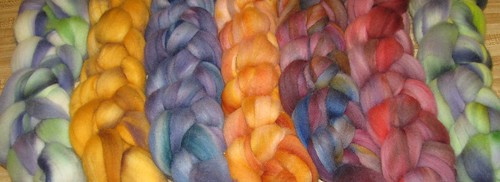
here's the first few... these are already up at the shop!
Sunday, December 27, 2009
an exciting Christmas
Christmas was much more exciting than we intended this year. J's brother and family were in Spearfish (about 50 miles away) with Grandma and Grandpa. On Christmas morning they drove to our house, and from there we went to J's cousins house nearby. The weather was lousy when they arrived at our house. it had snowed Christmas eve, light fluffy snow. On Christmas day it was snowing and blowing, but the roads didn't seem to bad on the way to J's cousin's house. OK, they were probably pretty bad, but we decided we would be sure to leave early, before it got dark and things would be fine.
We left the cousin's house and quite quickly encountered a drift all the way across the road about 3 feet deep. not surprisingly we got high centered. J's brother had gone the opposite way to go back to Spearfish with G&G. J called them and they headed back to help us get unstuck. a fab Fire Fighter happened by and pulled us out about the time the J's brother arrived. However, in the meantime the interstate had gotten bad enough so that the highway patrol closed it. This meant that G&G and J's brother and family had one place to go (since they couldn't get to G&G's house)--our little 3 bedroom trailer.
Christmas evening and the day after Christmas we had 13 people (3 were quite small ones) in our little 3 bedroom trailer that our family have 5 has pretty much outgrown. :-) Funny part? it was actually quite fun! I'm sure we all would have preferred it otherwise. our unexpected guests had no change of clothes, no toothbrushes, etc. BUT, kids slept all over the living room and on several bedroom floors and the couch. G&G took my daughters full size bed. Brother and family took my 2 son's bedroom--no full size bed, but a biggish room. and we played games and watched silly Christmas movies, and waited out the storm.
The interstate was open this morning. and now we are back to just our 5 selves... it's awefully quiet already, and the house feels huge. :-)
All and all i can only be thankful that we were together, there was food and heat and electricity, and good company! Just so there's a bit of yarn content here... i spent a bit of time teaching my SIL and niece to knit! passing on the addiction. :-) Life is good!
Hope your Christmas or other Winter Holiday was the best. Hope that you had time with family. Hope that you are now getting back to normal and the quiet is a blessing!
MERRY CHRISTMAS and for those friends who celebrate: Happy Boxing Day!
We left the cousin's house and quite quickly encountered a drift all the way across the road about 3 feet deep. not surprisingly we got high centered. J's brother had gone the opposite way to go back to Spearfish with G&G. J called them and they headed back to help us get unstuck. a fab Fire Fighter happened by and pulled us out about the time the J's brother arrived. However, in the meantime the interstate had gotten bad enough so that the highway patrol closed it. This meant that G&G and J's brother and family had one place to go (since they couldn't get to G&G's house)--our little 3 bedroom trailer.
Christmas evening and the day after Christmas we had 13 people (3 were quite small ones) in our little 3 bedroom trailer that our family have 5 has pretty much outgrown. :-) Funny part? it was actually quite fun! I'm sure we all would have preferred it otherwise. our unexpected guests had no change of clothes, no toothbrushes, etc. BUT, kids slept all over the living room and on several bedroom floors and the couch. G&G took my daughters full size bed. Brother and family took my 2 son's bedroom--no full size bed, but a biggish room. and we played games and watched silly Christmas movies, and waited out the storm.
The interstate was open this morning. and now we are back to just our 5 selves... it's awefully quiet already, and the house feels huge. :-)
All and all i can only be thankful that we were together, there was food and heat and electricity, and good company! Just so there's a bit of yarn content here... i spent a bit of time teaching my SIL and niece to knit! passing on the addiction. :-) Life is good!
Hope your Christmas or other Winter Holiday was the best. Hope that you had time with family. Hope that you are now getting back to normal and the quiet is a blessing!
MERRY CHRISTMAS and for those friends who celebrate: Happy Boxing Day!
Saturday, December 12, 2009
Northanger Abby & Dragons
This really isn't like Pride and Prejudice and Zombies... there'll just be a bit about each.
So... Northanger Abby yarn will be going out on Monday... if you haven't read it, you should know that the main character, Catherine Morland, is a teenager who loves Gothic novels. so i concluded that she is clearly the basis for current Goths. :-) or not... but one way or the other, the yarn is very Goth looking... dark and rich and romantic... totally my kind of colors.


In other news i've been working on a shawl pattern. this is my test of the idea... it's supposed to be a dragon tail and wings... we'll see how well it blocks out!

So... Northanger Abby yarn will be going out on Monday... if you haven't read it, you should know that the main character, Catherine Morland, is a teenager who loves Gothic novels. so i concluded that she is clearly the basis for current Goths. :-) or not... but one way or the other, the yarn is very Goth looking... dark and rich and romantic... totally my kind of colors.


In other news i've been working on a shawl pattern. this is my test of the idea... it's supposed to be a dragon tail and wings... we'll see how well it blocks out!

Monday, November 02, 2009
new blog announcement
i've started a new blog specifically about my designing. you should check it out!
http://knaughtyandtwisted.blogspot.com/
http://knaughtyandtwisted.blogspot.com/
Sunday, October 25, 2009
apple jelly and sauce
So... I spent part of today making some beautiful jelly. a customer gave me some gorgeous apples at sock class on Saturday, so i chopped up, cooked and drained apples, then i made jelly. it is the most beautiful pink champaign color. and the taste? well, i can't describe it....
before i've always put the remainer of the apples out to the compost. i felt a bit guilty about this. it's perfectly good apple pulp, just a little lacking in juice. so today, i tried something. i took the lovely apple pulp, ran it through my food mill twice (first time through on big chop, then on really find chop to get rid of all the apple peel). When i got done i had about 1.5 pints of pulp. i added about half a cup of white sugar, cooked it until it was had boiled for a bit. I felt like i needed to boil it since it had hung out in open air for all day, collecting little bacteria. i came away with a pint and a half of apple sauce. it'll be rather tart i think. hopefully it won't jell. that would be so ironic.
last week i made what i hoped would be peach jam, which turned into peach sauce, because it didn't jell. at all. not that it isn't yummy. we've already eaten a couple pints of the stuff--it delish on toast, or ice cream or cake... mmmm BUT, if my peach jam turns out to be peach sauce, and my apple sauce turns out to be apple jam, that would be a bit funny!
tomorrow--knitting!
before i've always put the remainer of the apples out to the compost. i felt a bit guilty about this. it's perfectly good apple pulp, just a little lacking in juice. so today, i tried something. i took the lovely apple pulp, ran it through my food mill twice (first time through on big chop, then on really find chop to get rid of all the apple peel). When i got done i had about 1.5 pints of pulp. i added about half a cup of white sugar, cooked it until it was had boiled for a bit. I felt like i needed to boil it since it had hung out in open air for all day, collecting little bacteria. i came away with a pint and a half of apple sauce. it'll be rather tart i think. hopefully it won't jell. that would be so ironic.
last week i made what i hoped would be peach jam, which turned into peach sauce, because it didn't jell. at all. not that it isn't yummy. we've already eaten a couple pints of the stuff--it delish on toast, or ice cream or cake... mmmm BUT, if my peach jam turns out to be peach sauce, and my apple sauce turns out to be apple jam, that would be a bit funny!
tomorrow--knitting!


Monday, October 19, 2009
goodness, it's been too long
i've been super distracted by the shop... i've gotten lots done lately. from indigo dyeing to designing patterns, i've been busy!


this is intended for socks... it's naturally dyed with chamomile, (for the yellow) and blackwalnut and purple logwood (for the black)


here's the results of a natural dyeing weekend... from coreopsis to black-eyed susans to purple logwood the colors were great


this is from my indigo dye pot. it was amazing to watch the color go from sort of greeny yellow to BLUE.

this is intended for socks... it's naturally dyed with chamomile, (for the yellow) and blackwalnut and purple logwood (for the black)

these are the socks... i'm loving them, but the heels are not happening like i'd like.


i've also been designing too... these little fingerless gloves and matching cowl came out really well.


a super lovely friend made this for me for my birthday... it matches the sheep on the sign for my shop. i love it!

Subscribe to:
Posts (Atom)